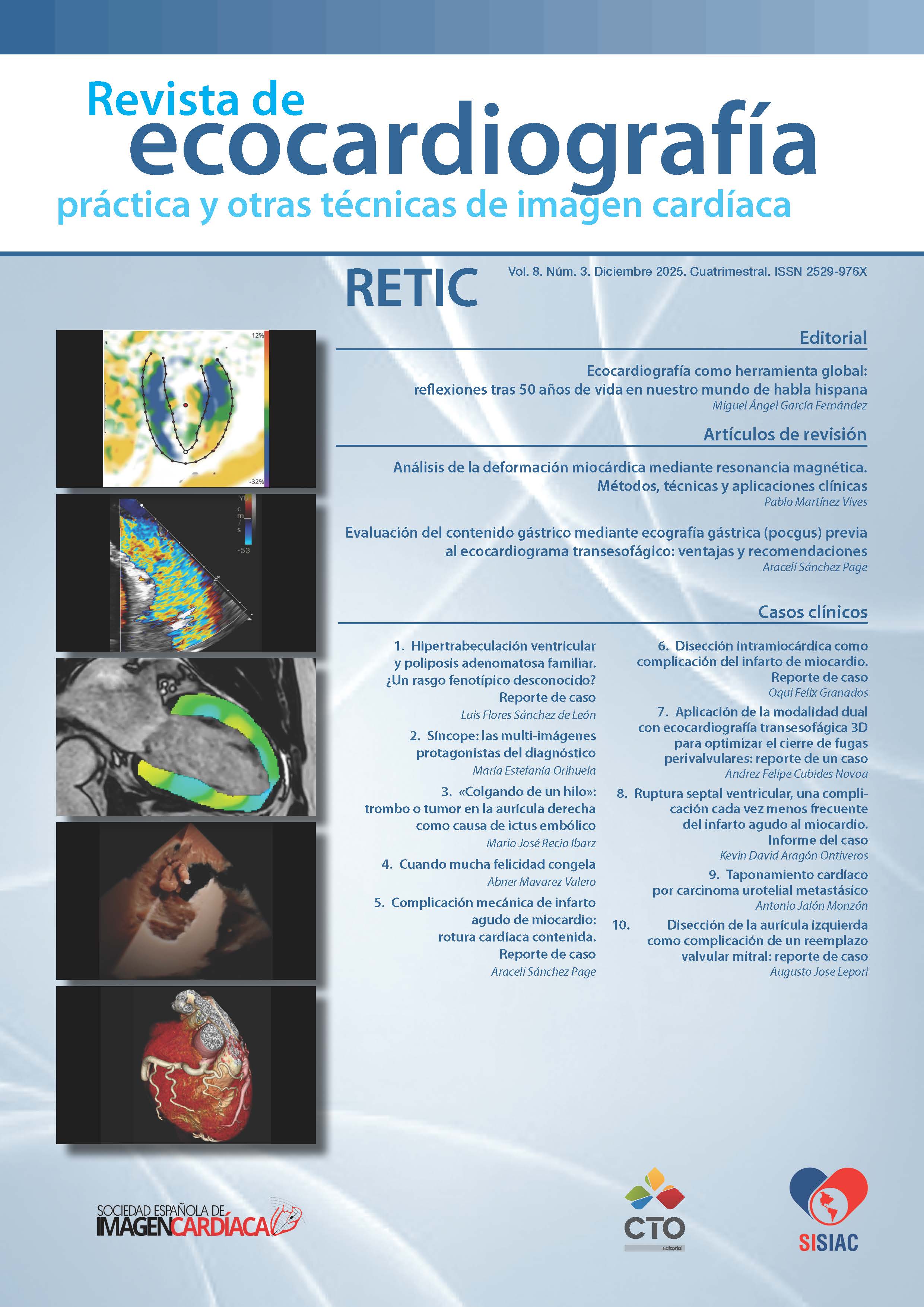
Análisis de la deformación miocárdica mediante resonancia magnética. Métodos, técnicas y aplicaciones clínicas.
DOI:
https://doi.org/10.37615/retic.v8n3a2Palabras clave:
resonancia magnética cardiaca, deformación miocárdica, cardiopatíasResumen
El estudio de la deformación miocárdica (strain) mediante diferentes técnicas se ha consolidado como un biomarcador sensible de la función cardíaca, aportando información incremental respecto a parámetros tradicionales como la fracción de eyección o el cambio de área fraccional. La resonancia magnética cardíaca (RMC) ofrece ventajas únicas para su análisis gracias a su elevada resolución espacial, reproducibilidad y capacidad de caracterización tisular. El propósito de esta revisión es resumir los conceptos básicos de la deformación miocárdica, describir las principales técnicas disponibles para su cuantificación mediante RMC y destacar sus aplicaciones clínicas, limitaciones y perspectivas de futuro.
Descargas
Métricas
Citas
Dandel M, Lehmkuhl H, Knosalla C, Suramelashvili N, Hetzer R. Strain and Strain Rate Imaging by Echocardiography - Basic Concepts and Clinical Applicability. Curr Cardiol Rev. 2009;5(2):133-148. https://doi.org/10.2174/157340309788166642 DOI: https://doi.org/10.2174/157340309788166642
Smiseth OA, Rider O, Cvijic M, Valkovič L, Remme EW, Voigt JU. Myocardial Strain Imaging: Theory, Current Practice, and the Future. JACC Cardiovasc Imaging. 2025;18(3):340-381. https://doi.org/10.1016/j.jcmg.2024.07.011 DOI: https://doi.org/10.1016/j.jcmg.2024.07.011
Swoboda PP, Erhayiem B, McDiarmid AK, et al. Relationship between cardiac deformation parameters measured by cardiovascular magnetic resonance and aerobic fitness in endurance athletes. Journal of Cardiovascular Magnetic Resonance. 2016;18(1):1-8. https://doi.org/10.1186/S12968-016-0266-X DOI: https://doi.org/10.1186/s12968-016-0266-x
Scatteia A, Baritussio A, Bucciarelli-Ducci C. Strain imaging using cardiac magnetic resonance. Heart Fail Rev. 2017;22(4):465. https://doi.org/10.1007/S10741-017-9621-8
Heimdal A, Støylen A, Torp H, Skjærpe T. Real-Time Strain Rate Imaging of the Left Ventricle by Ultrasound. Journal of the American Society of Echocardiography. 1998;11(11):1013-1019. https://doi.org/10.1016/S0894-7317(98)70151-8 DOI: https://doi.org/10.1016/S0894-7317(98)70151-8
Perk G, Tunick PA, Kronzon I. Non-Doppler Two-dimensional Strain Imaging by Echocardiography–From Technical Considerations to Clinical Applications. Journal of the American Society of Echocardiography. 2007;20(3):234-243. https://doi.org/10.1016/j.echo.2006.08.023 DOI: https://doi.org/10.1016/j.echo.2006.08.023
Bucius P, Erley J, Tanacli R, et al. Comparison of feature tracking, fast-SENC, and myocardial tagging for global and segmental left ventricular strain. ESC Heart Fail. 2020;7(2):523-532. https://doi.org/10.1002/ehf2.12576 DOI: https://doi.org/10.1002/ehf2.12576
Jeung MY, Germain P, Croisille P, Ghannudi S El, Roy C, Gangi A. Myocardial Tagging with MR Imaging: Overview of Normal and Pathologic Findings. RadioGraphics. 2012;32(5):1381-1398. https://doi.org/10.1148/rg.325115098 DOI: https://doi.org/10.1148/rg.325115098
Osman NF, Kerwin WS, McVeigh ER, Prince JL. Cardiac motion tracking using CINE harmonic phase (HARP) magnetic resonance imaging. Magn Reson Med. 1999;42(6):1048-1060. https://doi.org/10.1002/(SICI)1522-2594(199912)42:6<1048::AID-MRM9>3.0.CO;2-M DOI: https://doi.org/10.1002/(SICI)1522-2594(199912)42:6<1048::AID-MRM9>3.0.CO;2-M
Faragli A, Tanacli R, Kolp C, et al. Cardiovascular magnetic resonance-derived left ventricular mechanics—strain, cardiac power and end-systolic elastance under various inotropic states in swine. Journal of Cardiovascular Magnetic Resonance. 2020;22(1). https://doi.org/10.1186/S12968-020-00679-Z DOI: https://doi.org/10.1186/s12968-020-00679-z
Neizel M, Lossnitzer D, Korosoglou G, et al. Strain-encoded (SENC) magnetic resonance imaging to evaluate regional heterogeneity of myocardial strain in healthy volunteers: Comparison with conventional tagging. Journal of Magnetic Resonance Imaging. 2009;29(1):99-105. https://doi.org/10.1002/JMRI.21612 DOI: https://doi.org/10.1002/jmri.21612
Giusca S, Korosoglou G, Zieschang V, et al. Reproducibility study on myocardial strain assessment using fast-SENC cardiac magnetic resonance imaging. Sci Rep. 2018;8(1):14100. https://doi.org/10.1038/s41598-018-32226-3 DOI: https://doi.org/10.1038/s41598-018-32226-3
Pedrizzetti G, Claus P, Kilner PJ, Nagel E. Principles of cardiovascular magnetic resonance feature tracking and echocardiographic speckle tracking for informed clinical use. Journal of Cardiovascular Magnetic Resonance. 2016;18(1):1-12. https://doi.org/10.1186/S12968-016-0269-7
Claus P, Omar AMS, Pedrizzetti G, Sengupta PP, Nagel E. Tissue Tracking Technology for Assessing Cardiac Mechanics: Principles, Normal Values, and Clinical Applications. JACC Cardiovasc Imaging. 2015;8(12):1444-1460. https://doi.org/10.1016/j.jcmg.2015.11.001 DOI: https://doi.org/10.1016/j.jcmg.2015.11.001
Taylor RJ, Moody WE, Umar F, et al. Myocardial strain measurement with feature-tracking cardiovascular magnetic resonance: normal values. Eur Heart J Cardiovasc Imaging. 2015;16(8):871-881. https://doi.org/10.1093/EHJCI/JEV006 DOI: https://doi.org/10.1093/ehjci/jev006
Pedrizzetti G, Claus P, Kilner PJ, Nagel E. Principles of cardiovascular magnetic resonance feature tracking and echocardiographic speckle tracking for informed clinical use. Journal of Cardiovascular Magnetic Resonance. 2016;18(1):1-12. https://doi.org/10.1186/S12968-016-0269-7 DOI: https://doi.org/10.1186/s12968-016-0269-7
Schuster A, Stahnke VC, Unterberg-Buchwald C, et al. Cardiovascular magnetic resonance feature-tracking assessment of myocardial mechanics: Intervendor agreement and considerations regarding reproducibility. Clin Radiol. 2015;70(9):989-998. https://doi.org/10.1016/j.crad.2015.05.006 DOI: https://doi.org/10.1016/j.crad.2015.05.006
Rajiah PS, Kalisz K, Broncano J, et al. Myocardial Strain Evaluation with Cardiovascular MRI: Physics, Principles, and Clinical Applications. RadioGraphics. 2022;42(4):968-990. https://doi.org/10.1148/rg.210174
Kuijpers D, Ho KYJAM, Van Dijkman PRM, Vliegenthart R, Oudkerk M. Dobutamine cardiovascular magnetic resonance for the detection of myocardial ischemia with the use of myocardial tagging. Circulation. 2003;107(12):1592-1597. https://doi.org/10.1161/01.CIR.0000060544.41744.7C DOI: https://doi.org/10.1161/01.CIR.0000060544.41744.7C
Schneeweis C, Qiu J, Schnackenburg B, et al. Value of additional strain analysis with feature tracking in dobutamine stress cardiovascular magnetic resonance for detecting coronary artery disease. Journal of Cardiovascular Magnetic Resonance. 2014;16(1). https://doi.org/10.1186/s12968-014-0072-2 DOI: https://doi.org/10.1186/s12968-014-0072-2
Riffel JH, Siry D, Salatzki J, et al. Feasibility of fast cardiovascular magnetic resonance strain imaging in patients presenting with acute chest pain. PLoS One. 2021;16(5):e0251040. https://doi.org/10.1371/JOURNAL.PONE.0251040 DOI: https://doi.org/10.1371/journal.pone.0251040
Ochs MM, Kajzar I, Salatzki J, et al. Hyperventilation/Breath-Hold Maneuver to Detect Myocardial Ischemia by Strain-Encoded CMR: Diagnostic Accuracy of a Needle-Free Stress Protocol. JACC Cardiovasc Imaging. 2021;14(10):1932-1944. https://doi.org/10.1016/J.JCMG.2021.02.022 DOI: https://doi.org/10.1016/j.jcmg.2021.02.022
Khan JN, Singh A, Nazir SA, Kanagala P, Gershlick AH, McCann GP. Comparison of cardiovascular magnetic resonance feature tracking and tagging for the assessment of left ventricular systolic strain in acute myocardial infarction. Eur J Radiol. 2015;84(5):840-848. https://doi.org/10.1016/j.ejrad.2015.02.002 DOI: https://doi.org/10.1016/j.ejrad.2015.02.002
Yu S, Zhou J, Yang K, et al. Correlation of Myocardial Strain and Late Gadolinium Enhancement by Cardiac Magnetic Resonance After a First Anterior ST-Segment Elevation Myocardial Infarction. Front Cardiovasc Med. 2021;8:705487. https://doi.org/10.3389/FCVM.2021.705487 DOI: https://doi.org/10.3389/fcvm.2021.705487
Schuster A, Hor KN, Kowallick JT, Beerbaum P, Kutty S. Cardiovascular Magnetic Resonance Myocardial Feature Tracking: Concepts and Clinical Applications. Circ Cardiovasc Imaging. 2016;9(4). https://doi.org/10.1161/CIRCIMAGING.115.004077 DOI: https://doi.org/10.1161/CIRCIMAGING.115.004077
Wamil M, Borlotti A, Liu D, et al. Combined T1-mapping and tissue tracking analysis predicts severity of ischemic injury following acute STEMI—an Oxford Acute Myocardial Infarction (OxAMI) study. International Journal of Cardiovascular Imaging. 2019;35(7):1297-1308. https://doi.org/10.1007/S10554-019-01542-8 DOI: https://doi.org/10.1007/s10554-019-01542-8
Buss SJ, Breuninger K, Lehrke S, et al. Assessment of myocardial deformation with Cardiac magnetic resonance strain imaging improves risk stratification in patients with dilated cardiomyopathy. Eur Heart J Cardiovasc Imaging. 2015;16(3):307-315. https://doi.org/10.1093/EHJCI/JEU181 DOI: https://doi.org/10.1093/ehjci/jeu181
Negri F, Sanna GD, Di Giovanna G, et al. Cardiac Magnetic Resonance Feature-Tracking Identifies Preclinical Abnormalities in Hypertrophic Cardiomyopathy Sarcomere Gene Mutation Carriers. Circ Cardiovasc Imaging. 2024;17(4):E016042. https://doi.org/10.1161/CIRCIMAGING.123.016042 DOI: https://doi.org/10.1161/CIRCIMAGING.123.016042
Martínez-Vives P, Cecconi A, Vera A, et al. Usefulness of Tissue Tracking by Cardiac Magnetic Resonance to Predict Events in Patients With Hypertrophic Cardiomyopathy. American Journal of Cardiology. 2022;174:126-135. https://doi.org/10.1016/j.amjcard.2022.03.024 DOI: https://doi.org/10.1016/j.amjcard.2022.03.024
Nucifora G, Muser D, Gianfagna P, Morocutti G, Proclemer A. Systolic and diastolic myocardial mechanics in hypertrophic cardiomyopathy and their link to the extent of hypertrophy, replacement fibrosis and interstitial fibrosis. International Journal of Cardiovascular Imaging. 2015;31(8):1603-1610. https://doi.org/10.1007/S10554-015-0720-0 DOI: https://doi.org/10.1007/s10554-015-0720-0
Scatteia A, Baritussio A, Bucciarelli-Ducci C. Strain imaging using cardiac magnetic resonance. Heart Fail Rev. 2017;22(4):465. https://doi.org/10.1007/S10741-017-9621-8 DOI: https://doi.org/10.1007/s10741-017-9621-8
Vos JL, Raafs AG, van der Velde N, et al. Comprehensive Cardiovascular Magnetic Resonance‐Derived Myocardial Strain Analysis Provides Independent Prognostic Value in Acute Myocarditis. Journal of the American Heart Association: Cardiovascular and Cerebrovascular Disease. 2022;11(19):e025106. https://doi.org/10.1161/JAHA.121.025106 DOI: https://doi.org/10.1161/JAHA.121.025106
Muser D, Castro SA, Santangeli P, Nucifora G. Clinical applications of feature-tracking cardiac magnetic resonance imaging. World J Cardiol. 2018;10(11):210. https://doi.org/10.4330/WJC.V10.I11.210 DOI: https://doi.org/10.4330/wjc.v10.i11.210
Prati G, Vitrella G, Allocca G, et al. Right Ventricular Strain and Dyssynchrony Assessment in Arrhythmogenic Right Ventricular Cardiomyopathy: Cardiac Magnetic Resonance Feature-Tracking Study. Circ Cardiovasc Imaging. 2015;8(11). https://doi.org/10.1161/CIRCIMAGING.115.003647 DOI: https://doi.org/10.1161/CIRCIMAGING.115.003647
Reddy A, Singh V, Karthikeyan B, et al. Biventricular strain imaging with cardiac mri in genotyped and histology validated amyloid cardiomyopathy. Cardiogenetics. 2021;11(3):98-110. https://doi.org/10.3390/CARDIOGENETICS11030011/S1 DOI: https://doi.org/10.3390/cardiogenetics11030011
Illman JE, Arunachalam SP, Arani A, et al. MRI feature tracking strain is prognostic for all-cause mortality in AL amyloidosis. Amyloid. 2018;25(2):101. https://doi.org/10.1080/13506129.2018.1465406 DOI: https://doi.org/10.1080/13506129.2018.1465406
Martínez-Vives P, Cecconi A, Vera A, et al. Tissue tracking analysis and left ventricular outflow tract obstruction in patients with hypertrophic cardiomyopathy. Magn Reson Imaging. 2025;119:110363. https://doi.org/10.1016/J.MRI.2025.110363 DOI: https://doi.org/10.1016/j.mri.2025.110363
Korosoglou G, Giusca S, Montenbruck M, et al. Fast Strain-Encoded Cardiac Magnetic Resonance for Diagnostic Classification and Risk Stratification of Heart Failure Patients. JACC Cardiovasc Imaging. 2021;14(6):1177-1188. https://doi.org/10.1016/J.JCMG.2020.10.024/SUPPL_FILE/MMC1.DOCX DOI: https://doi.org/10.1016/j.jcmg.2020.10.024
Ajmone Marsan N, Delgado V, Shah DJ, et al. Valvular heart disease: shifting the focus to the myocardium. Eur Heart J. 2023;44(1):28-40. https://doi.org/10.1093/eurheartj/ehac504 DOI: https://doi.org/10.1093/eurheartj/ehac504
Tsampasian V, Hothi SS, Ravindrarajah T, Swift AJ, Garg P, Vassiliou VS. Valvular Cardiomyopathy: The Value of Cardiovascular Magnetic Resonance Imaging. Cardiol Res Pract. 2022;2022:3144386. https://doi.org/10.1155/2022/3144386
Spath NB, Gomez M, Everett RJ, et al. Global Longitudinal Strain Analysis Using Cardiac MRI in Aortic Stenosis: Comparison with Left Ventricular Remodeling, Myocardial Fibrosis, and 2-year Clinical Outcomes. Radiol Cardiothorac Imaging. 2019;1(4):e190027. https://doi.org/10.1148/RYCT.2019190027 DOI: https://doi.org/10.1148/ryct.2019190027
Burris NS, Lima APS, Hope MD, Ordovas KG. Feature Tracking Cardiac MRI Reveals Abnormalities in Ventricular Function in Patients With Bicuspid Aortic Valve and Preserved Ejection Fraction. Tomography. 2018;4(1):26-32. https://doi.org/10.18383/J.TOM.2018.00005 DOI: https://doi.org/10.18383/j.tom.2018.00005
Romano S, Kitkungvan D, Nguyen DT, et al. Implications of myocardial strain in primary mitral regurgitation-a cardiovascular magnetic resonance study. Eur Heart J Cardiovasc Imaging. 2024;26(1):126-134. https://doi.org/10.1093/EHJCI/JEAE245 DOI: https://doi.org/10.1093/ehjci/jeae245
Jeong D, Gladish G, Chitiboi T, Fradley MG, Gage KL, Schiebler ML. MRI in cardio-oncology: A review of cardiac complications in oncologic care. J Magn Reson Imaging. 2019;50(5):1349-1366. https://doi.org/10.1002/JMRI.26895 DOI: https://doi.org/10.1002/jmri.26895
Rajiah PS, Kalisz K, Broncano J, et al. Myocardial Strain Evaluation with Cardiovascular MRI: Physics, Principles, and Clinical Applications. Radiographics. 2022;42(4):968-990. https://doi.org/10.1148/RG.210174/ASSET/IMAGES/LARGE/RG.210174.FIG23.JPEG DOI: https://doi.org/10.1148/rg.210174
Drafts BC, Twomley KM, D’Agostino R, et al. Low to Moderate Dose Anthracycline-Based Chemotherapy is Associated with Early Noninvasive Imaging Evidence of Subclinical Cardiovascular Disease. JACC Cardiovasc Imaging. 2013;6(8):877. https://doi.org/10.1016/J.JCMG.2012.11.017 DOI: https://doi.org/10.1016/j.jcmg.2012.11.017
Houbois CP, Nolan M, Somerset E, et al. Serial Cardiovascular Magnetic Resonance Strain Measurements to Identify Cardiotoxicity in Breast Cancer: Comparison With Echocardiography. JACC Cardiovasc Imaging. 2021;14(5):962-974. https://doi.org/10.1016/J.JCMG.2020.09.039 DOI: https://doi.org/10.1016/j.jcmg.2020.09.039
Giusca S, Korosoglou G, Montenbruck M, et al. Multiparametric Early Detection and Prediction of Cardiotoxicity Using Myocardial Strain, T1 and T2 Mapping, and Biochemical Markers: A Longitudinal Cardiac Resonance Imaging Study during 2 Years of Follow-Up. Circ Cardiovasc Imaging. 2021;14(6):E012459. https://doi.org/10.1161/CIRCIMAGING.121.012459/SUPPL_FILE/APPENDIX DOI: https://doi.org/10.1161/CIRCIMAGING.121.012459
Kwan JM, Arbune A, Henry ML, et al. Quantitative cardiovascular magnetic resonance findings and clinical risk factors predict cardiovascular outcomes in breast cancer patients. PLoS One. 2023;18(5). https://doi.org/10.1371/JOURNAL.PONE.0286364 DOI: https://doi.org/10.1371/journal.pone.0286364
Tsampasian V, Hothi SS, Ravindrarajah T, Swift AJ, Garg P, Vassiliou VS. Valvular Cardiomyopathy: The Value of Cardiovascular Magnetic Resonance Imaging. Cardiol Res Pract. 2022;2022:3144386. https://doi.org/10.1155/2022/3144386 DOI: https://doi.org/10.1155/2022/3144386
Korosoglou G, Sagris M, André F, et al. Systematic review and meta-analysis for the value of cardiac magnetic resonance strain to predict cardiac outcomes. Sci Rep. 2024;14(1):1094. https://doi.org/10.1038/S41598-023-50835-5 DOI: https://doi.org/10.1038/s41598-023-50835-5
Descargas
Publicado
Cómo citar
Número
Sección
Licencia
Derechos de autor 2025 Pablo Martinez Vives

Esta obra está bajo una licencia internacional Creative Commons Atribución-NoComercial-SinDerivadas 4.0.
RETIC se distribuye bajo la licencia Creative Commons Reconocimiento-NoComercial-SinDerivadas 4.0 Internacional (CC BY-NC-ND 4.0) https://creativecommons.org/licenses/by-nc-nd/4.0 que permite compartir, copiar y redistribuir el material en cualquier medio o formato, bajo los siguientes términos:
- Reconocimiento: debe otorgar el crédito correspondiente, proporcionar un enlace a la licencia e indicar si se realizaron cambios. Puede hacerlo de cualquier manera razonable, pero no de ninguna manera que sugiera que el licenciante lo respalda a usted o su uso.
- No comercial: no puede utilizar el material con fines comerciales.
- No Derivados: si remezcla, transforma o construye sobre el material, no puede distribuir el material modificado.
- Sin restricciones adicionales: no puede aplicar términos legales o medidas tecnológicas que restrinjan legalmente a otros de hacer cualquier cosa que permita la licencia.