Multimodality imaging in cardiac arrest secondary to severe pectus excavatum and aortic regurgitation: case report
DOI:
https://doi.org/10.37615/retic.v9n1a10Keywords:
pectus excavatum, aortic valve insufficiency, cardiac arrest, case reportAbstract
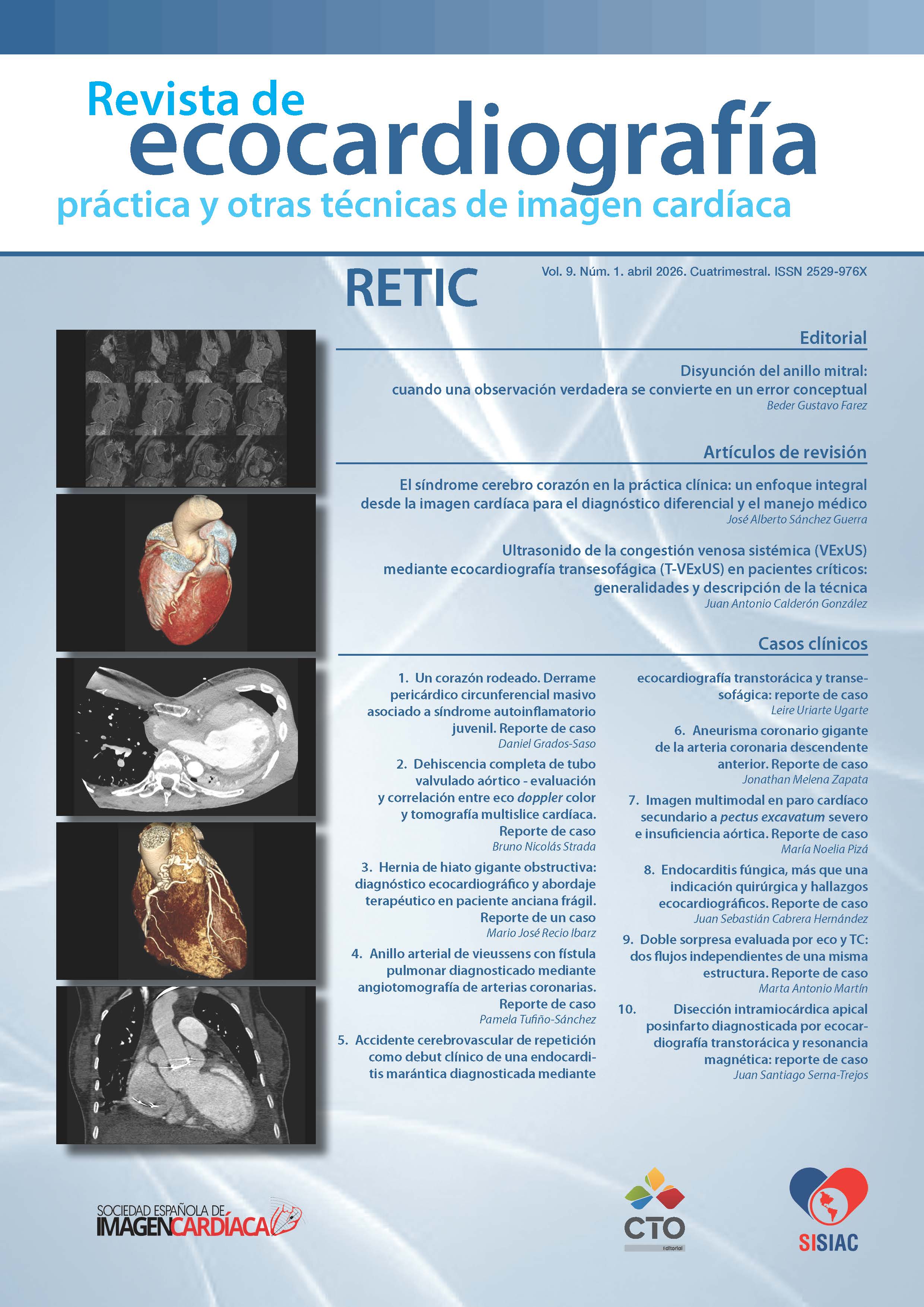
Pectus excavatum is the most common congenital deformity of the chest cavity. In severe cases, it can compress the heart chambers and cause serious complications. We present the case of a 44-year-old man who was resuscitated from cardiac arrest in which severe pectus excavatum coexisted with severe aortic insufficiency. Imaging studies showed that the heart was markedly displaced to the left hemithorax and that there was a narrowing with kinking of the origin of the right coronary artery. It also allowed to quantify the severity of the aortic insufficiency. In this case, multimodal cardiac imaging was essential for identifying the impact of pectus excavatum and aortic insufficiency on cardiac structure and function, which made it possible to establish the pathophysiological mechanism of cardiac arrest and guide clinical management.
Downloads
Metrics
References
Acipayam A, Güllü UU, Güngör Ş. Cardiac anomalies in pediatric patients with pectus excavatum. Rev Assoc Med Bras. 2023;69(7):e20221301. http://dx.doi.org/10.1590/1806-9282.20221301 DOI: https://doi.org/10.1590/1806-9282.20221301
Jaroszewski DE, Fonkalsrud EW. Repair of pectus chest deformities in 320 adult patients: 21 year experience. Ann Thorac Surg. 2007;84(2):429-33. http://dx.doi.org/10.1016/j.athoracsur.2007.03.077 DOI: https://doi.org/10.1016/j.athoracsur.2007.03.077
Sonaglioni A, Nicolosi GL, Trevisan R, Lombardo M, Grasso E, Gensini GF, et al. The influence of pectus excavatum on cardiac kinetics and function in otherwise healthy individuals: A systematic review. Int J Cardiol. 2023;381:135-44. http://dx.doi.org/10.1016/j.ijcard.2023.03.058 DOI: https://doi.org/10.1016/j.ijcard.2023.03.058
Awad SFM, Barbosa-Barros R, Belem L de S, Cavalcante CP, Riera ARP, Garcia-Niebla J, et al. Brugada phenocopy in a patient with pectus excavatum: systematic review of the ECG manifestations associated with pectus excavatum. Ann Noninvasive Electrocardiol. 2013;18(5):415-20. http://dx.doi.org/10.1111/anec.12082 DOI: https://doi.org/10.1111/anec.12082
Ravasin A, Viggiano D, Tombelli S, Checchi L, Stefàno P, Voltolini L, et al. Heart disease and pectus excavatum: An underestimated issue-single center experience and literature review. Life (Basel). 2024;14(12):1643. http://dx.doi.org/10.3390/life14121643 DOI: https://doi.org/10.3390/life14121643
Moossdorff M, Maesen B, den Uijl DW, Lenderink T, Franssen FAR, Vissers YLJ, et al. Case report: ventricular fibrillation and cardiac arrest provoked by forward bending in adolescent with severe pectus excavatum. Eur Heart J Case Rep. 2021;5(10):ytab373. http://dx.doi.org/10.1093/ehjcr/ytab373 DOI: https://doi.org/10.1093/ehjcr/ytab373
Pimenta J, Vieira A, Henriques-Coelho T. Ventricular arrhythmia solved by surgical correction of pectus excavatum. Interact Cardiovasc Thorac Surg. 2018;26(4):706-8. http://dx.doi.org/10.1093/icvts/ivx397 DOI: https://doi.org/10.1093/icvts/ivx397
Checchi L, Perrotta L, Ricciardi G, Colella A, Bambagioni G, Ciliberti D, et al. S-ICD implantation in secondary prevention in a young patient with recent surgically repaired pectus excavatum. JACC. Case Rep. 2024;29(5), 102231. https://doi.org/10.1016/j.jaccas.2024.102231 DOI: https://doi.org/10.1016/j.jaccas.2024.102231
Downloads
Published
How to Cite
Issue
Section
License
Copyright (c) 2026 María Noelia Pizá, Lucía Fernández Gassó

This work is licensed under a Creative Commons Attribution-NonCommercial-NoDerivatives 4.0 International License.
RETIC is distributed under the Creative Commons Attribution-NonCommercial-NoDerivatives 4.0 International (CC BY-NC-ND 4.0) license https://creativecommons.org/licenses/by-nc-nd/4.0 which allows sharing, copying and redistribution of the material in any medium or format, under the following terms:
- Attribution: you must give appropriate credit, provide a link to the license, and indicate if changes were made. You may do so in any reasonable manner, but not in any way that suggests that the licensor endorses you or your use.
- Non-commercial: you may not use the material for commercial purposes.
- No Derivatives: if you remix, transform or build upon the material, you may not distribute the modified material.
- No Additional Restrictions: you may not apply legal terms or technological measures that legally restrict others from doing anything permitted by the license.